It is not merely a technique; it is the embodiment of a digital concept. It is the transition from a pure idea—calculated by an algorithm or a graphic design concept—to a physical reality that challenges our visual expectations.
The Dialogue Between Forms and Colors: A New Dimension
At the heart of this approach lies the emphasis on the dialogue between forms and colors. In traditional abstraction, color and form coexist on the same plane. They play on contrasts in value, temperature, or saturation. But when the concept of extension is introduced, this dialogue changes in nature: it becomes spatial.
Space is no longer an illusion created by perspective or gradation; it becomes a physical component of the work. By extending beyond the frame, the forms cast real shadows that alter the perception of adjacent colors depending on the time of day or the viewing angle. It is a living conversation, a choreography between natural light and artificial structure.
Redefining the Path of the Gaze
In a classical work, the eye moves in a linear or circular fashion from a filled area to an empty one. We seek balance, a focal point, and rest. In augmented abstraction, this rule is transcended.
“The eye no longer moves merely from a filled area to an empty one, but also into the space above, creating a complex path that invites the viewer to explore.”
The viewer is no longer a mere passive spectator before an image; they become an explorer. By adding this “altitude” to the work, we force the gaze to dive into the interstices, to navigate around the reliefs, and to grasp the depth. The void is no longer merely the absence of color on the paper; it is the very air circulating between the layers of the work. This complex journey transforms the act of looking into an immersive experience.
The Clash of Textures: From Perfection to Roughness
One of the most fascinating aspects of this practice lies in the duality of materials. Augmented abstraction plays on a striking contrast that challenges our relationship with technology and the artist’s hand.
Paper Prints: The Legacy of the Virtual
On one hand, we have the perfection of paper printing. Smooth, sharp, almost surgical, it represents the digital world in its purest form. This is the realm of the invisible pixel, the mathematically perfect Bézier curve, and absolute color. It embodies the ideal vision of the original concept.
3D Printing: The Return of the “Gesture”
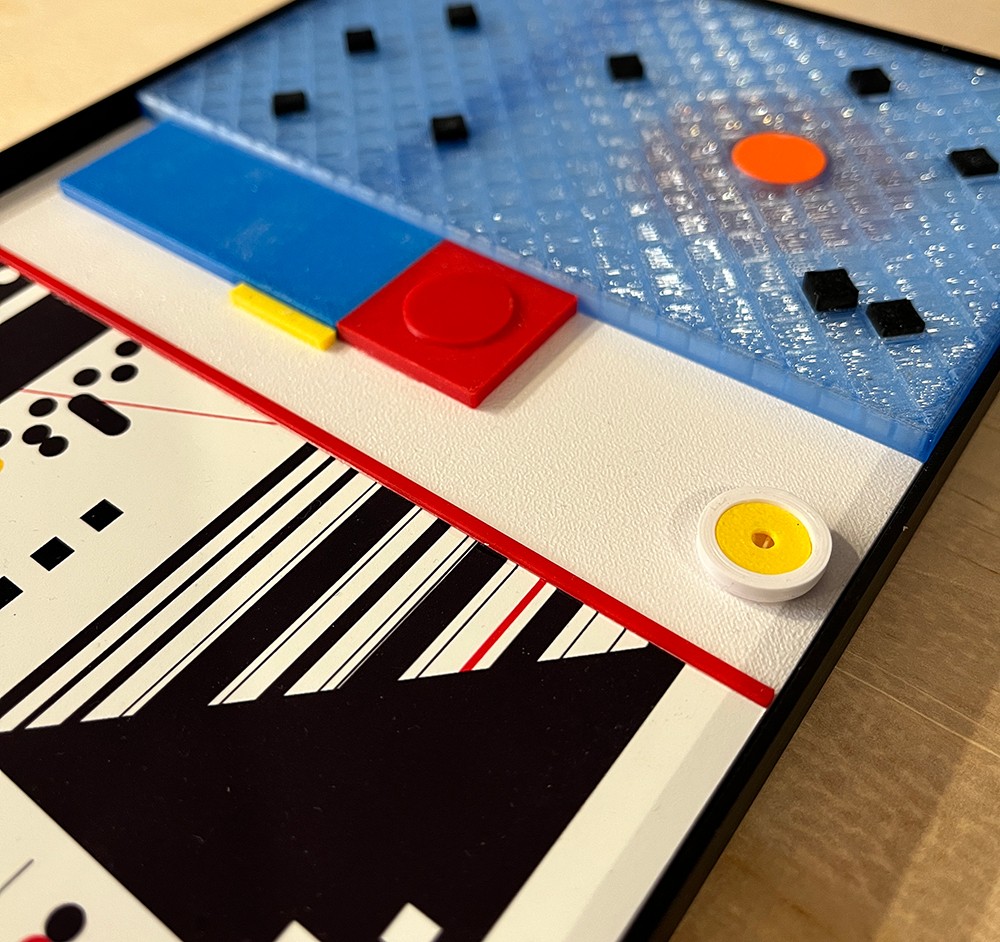
On the other hand, this perfection clashes with the rough finish of 3D printing. What is fascinating here is the paradox: a cutting-edge technology that, by its additive nature, evokes the organic quality of the brushstrokes in a classical painting.
The streaks of deposited material, the slight irregularities, the granularity of the printed object... all of this recreates a form of technological “craftsmanship.” We find traces of the artist’s touch, the accumulation of material that was once the exclusive domain of the painter applying oil paint thickly to the canvas. This encounter between the smooth and the rough creates a tactile tension essential to augmented abstraction.
Asymmetry at Height: Gaining Elevation
In my work, asymmetry is not a lack of balance, but a driving force. It is what prevents the eye from becoming fixed. When this asymmetry gains elevation, it creates a dynamic of disruption.
By elevating certain elements of the composition above others, I create a shifting visual hierarchy. Depending on where you stand, one form may hide another, or a texture may reveal a color that was previously invisible. This is the essence of augmented abstraction: it never reveals itself fully at a single glance. It demands time, movement, and curiosity.
Multiple Levels of Interpretation: A Layered Work
Augmented abstraction, by definition, offers multiple levels of interpretation. It can be approached in three distinct ways, much like peeling the layers of an onion:
Graphic interpretation (Content): We analyze the overall composition and the balance of colored masses on the flat surface. This is the intellectual understanding of the image.
Architectural interpretation (Form): We observe how volumes rise and how shadows define the space. This is the physical apprehension of the relief.
Temporal interpretation (Experience): This is the synthesis of the first two, enhanced by the viewer’s movement. The work changes; it “vibrates” as we move.
Conclusion: Toward a Hybrid Art
Augmented abstraction is not an end in itself, but a rapidly expanding language. By merging the precision of the digital with the raw presence of matter, it reminds us that art is above all a matter of space and perception. Which raises the following question: Is art what we perceive or what we feel?